My novel about love, betrayal and chess in New Orleans: The Pride and the Sorrow

Showing posts with label death. Show all posts

Thursday, January 28, 2010

J D Salinger dies, aged 91

Catcher in the Rye author JD Salinger has died of natural causes at his home in New Hampshire.

JD Salinger, who shocked one generation and inspired another with a classic novel of teenage rebellion, has died in New Hampshire at the age of 91.

Salinger, who shied away from publicity and did not publish an original work during the last 45 years of his life, was the creator of Holden Caulfield, the delinquent, alienated anti-hero of The Catcher in the Rye, which became required reading for generations of teenagers after its publication in 1951.

But in recent years its relevance to modern youth came into question and his reputation was tarnished by two accounts, one by a former lover and the other by one of Salinger's daughters, who painted him as a controlling and unpleasant eccentric.

The Catcher in the Rye was praised by the New York Times on publication as "an unusually brilliant first novel". But while an instant hit with many teenagers who related to its tale of adolescent angst and adult hypocrisy, it was met with alarm in other quarters. Some school boards made it required reading. Others banned it amid protests from parents over swearing – including the frequent use of "goddam" and, more rarely, "fuck" – as well as the bad example they believed Holden set.

Four years after its publication Salinger expressed disappointment that the book, which he acknowledged was based on his own upbringing, had met with some hostility.

"I'm aware that a number of my friends will be saddened, or shocked, or shocked-saddened, over some of the chapters of The Catcher in the Rye. Some of my best friends are children. In fact all of my best friends are children," he wrote in 20th Century Authors. "It's almost unbearable to me to realise that my book will be kept on a shelf out of their reach."

John Lennon's murderer, Mark Chapman, cited The Catcher in the Rye as an inspiration for the killing in 1980.

Salinger published other books, including the well received Nine Stories and Franny and Zooey, before he became an almost total recluse. His last published work – Hapworth 16, 1928 – was printed in The New Yorker in 1965.

Ten years ago it was revealed that Salinger had a secret cache of about 15 novels that had never been published. In his last interview, in 1980, he said that he only wrote for himself.

In 1986 Salinger won an injunction against the publication of a collection of his letters. During the case, which went all the way to the US supreme court, he was asked what he had been working on for the previous 20 years.

"Just a work of fiction," Salinger said in a deposition. "That's all. That's the only description I can really give it ... It's almost impossible to define. I work with characters, and as they develop I just go on from there."

Salinger was born in New York City on New Year's Day 1919. His father, of Polish Jewish origin, became wealthy importing cheese and meat. His mother posed as Jewish and he did not find out that she was not until after his bar mitzvah.

Salinger had his own troubled history in various schools until he was dispatched to Valley Forge military academy at the age of 15. There he began writing at night using a torch under his bed covers and published his first story in a fiction magazine in 1940.

He submitted a number of stories to the New Yorker that were rejected, including one called I Went to School with Adolf Hitler. But the magazine did accept a later story about a disaffected teenager called Holden Caulfield, the first time the character appeared.

In 1942 Salinger was conscripted to fight in the second world war where he took part in the Normandy landings. He married a German woman while serving with the occupation forces after the defeat of Hitler. The couple moved to America but the marriage soon fell apart. Salinger took up Zen Buddhism.

He found fame disagreeable and the year after the publication of his most famous novel he left New York city for the town of Cornish, New Hampshire. There he remarried, to Claire Douglas, had two children, and then divorced in 1967.

Periodically the spotlight shone on Salinger again.

In 1998 the writer Joyce Maynard published a memoir in which she wrote unflatteringly about an eight-month affair with Salinger in which she described his controlling personality. Two years later one of Salinger's daughters, Margaret, wrote of her father as a recluse who drank his own urine and spoke in tongues.

Salinger was thrust into public view one last time a year ago when he sued to block the publication of an unauthorised sequel to The Catcher in the Rye called 60 Years Later. The writer, John David California, imagined Holden in his 70s.

--

Chris McGreal in Washington, The Guardian, Thursday 28 January


Monday, January 25, 2010

Martin Amis in new row over 'euthanasia booths'

Martin Amis has never fought shy of an argument, whether it be with the critic Terry Eagleton (over Islamist extremism), his pal Christopher Hitchens (over Stalin) or fellow novelist Julian Barnes (over Amis leaving his agent – Barnes's wife).

But none of those opponents were as tough as his new target promises to be. Now 60, Amis has picked a fight with the grey power of Britain's ageing population, calling for euthanasia "booths" on street corners where they can terminate their lives with "a martini and a medal".

The author of Time's Arrow and London Fields said in an interview at the weekend that he believes Britain faces a "civil war" between young and old, as a "silver ­tsunami" of increasingly ageing people puts pressure on society.

"They'll be a population of demented very old people, like an invasion of terrible immigrants, stinking out the restaurants and cafes and shops," he said. "I can imagine a sort of civil war between the old and the young in 10 or 15 years' time.

"There should be a booth on every ­corner where you could get a martini and a medal," he added.

His comments were immediately condemned as "glib" and "offensive" by anti-euthanasia groups and those caring for the elderly and infirm. Supporters of assisted suicide, meanwhile, insisted that a dignified and compassionate end should be on offer to those who are dying.

Alistair Thompson, from the Care Not Killing Alliance, said Amis's views were "very worrying". "We are extremely disappointed that people are advocating death booths for the elderly and the disabled. How on earth can we pretend to be a civilised society if people are giving the oxygen of publicity to such proposals?

"What are these death booths? Are they going to be a kind of superloo where you put in a couple of quid and get a lethal cocktail?"

The Alzheimer's Society said there were 700,000 people with dementia in the UK and the figures were set to rise. "It is understandable that people in the early stages of dementia may reflect on the subject of euthanasia," said Andrew Ketteringham, of the Alzheimer's Society. "However, glib and offensive comments about 'euthanasia booths' and 'demented old people' only serve to alienate those dealing with this devastating condition and sidestep the hugely important question of how we can best support those affected to live well and maintain their dignity."

Amis, whose forthcoming novel, The Pregnant Widow, is due to be released shortly, stood by his comments, made in an interview in the Sunday Times.

He told the Guardian: "What we need to recognise is that certain lives fall into the negative, where pain hugely dwarfs those remaining pleasures that you may be left with. Geriatric science has been allowed to take over and, really, decency roars for some sort of correction." He said his comments were meant to be "satirical", rather than "glib".

His stance on euthanasia had hardened since the deaths of his stepfather, Lord Kilmarnock, the former SDP peer and writer, in March aged 81, and his friend Dame Iris Murdoch, the novelist, in 1999, aged 79, two years after her husband revealed that she was suffering from Alzheimer's.

"I increasingly feel that religion is so deep in our constitution and in our minds and that is something we should just peel off," he said. "Of course euthanasia is open to abuse, in that the typical grey death will be that of an old relative whose family gets rid of for one reason or another, and they'll say 'he asked me to do it', or 'he wanted to die', Amis said. "That's what we will have to look out for. Nonetheless, it is something we have to make some progress on."

Answering critics who said his comments were "offensive' to older people, Amis, a grandfather, said: "Well, I'm not a million miles away from that myself."

He added: "I had a friend who was desperately ill and she wanted to go to Switzerland, to Dignitas, but she was defeated by bureaucracy at this end. And, I think it is existentially more terrifying to feel that life is something you can't get out of.

"Frankly, I can't think of any reason for prolonging life once the mind goes. You are without dignity then."

In his interview, Amis said his step­father had died "very horribly". "He always thought he was going to get better. But he didn't get better and I think the denial of death is a great curse."

He said Iris Murdoch, whom he had known for a very long time , was "a friend, I loved her. She was wonderful. I remember talking to her just as it started happening, and she said, 'I've entered a dark place'. That famous quote. Awareness of loss is gone, the track is gone. You don't know the day you've spent watching Teletubbies; it just vanished."

The pro-euthanasia pressure group Dignity in Dying said: "Like all too many people in the UK, Martin Amis has witnessed the bad death of a loved one." But, it added: "Dignity in Dying's campaign for a change in the law is not about the introduction of 'euthanasia booths', nor is it in anticipation of a 'silver tsunami'. Our campaign is about allowing dying adults who have mental capacity a compassionate choice to end their suffering, subject to strict legal safeguards."

--

Caroline Davies, Sunday 24 January 2010


Tuesday, September 01, 2009

Why'd He Do It? Post-Mortem of a Grisly Death

BOOKS
Books of The Times: Why'd He Do It? Post-Mortem of a Grisly Death
By JANET MASLIN
A sickening account of a murder and suicide that riveted post-Katrina New Orleans.

Zackery Bowen appears on the cover of “Shake the Devil Off” as a lanky, handsome guy in a baseball cap, sitting in the French Quarter of New Orleans and staring at the camera with the insouciance of an off-duty movie star. In one hand he holds a wine glass. In the other hand he holds a kitten.

No word on whether the kitten escaped Zack unscathed. But the soused-looking woman sitting next to him in this same photograph, Addie Hall, did not fare well. She wound up the victim of a murder that was grisly even by New Orleans’s high standards. Let’s skip the particulars except to say that “Gal Pal Gumbo” was The New York Post’s headline for a story about Addie’s grisly murder, and that one of the most pleasant assertions that Ethan Brown, Zack’s biographer, can make on his subject’s behalf is that rumors of Zack’s cannibalism were simply not true.

At this point it might be reasonable to ask why Mr. Brown decided to write a whole book about Zack, who wound up jumping off a roof after he messily dispatched Addie. One answer is that Mr. Brown happened to be in the neighborhood. He and his wife were celebrating their wedding anniversary in New Orleans in the fall of 2006, just as Zack and Addie and their story’s gory details became the talk of the town.

When Mr. Brown learned that Zack had endured a trifecta of earlier nightmares — military service in Kosovo, military service in Baghdad and then Hurricane Katrina — he wondered if this was not the story of a true American tragedy. So he decided to delve (his word, though wallow would be more accurate) into the sad particulars of Zack’s unrelentingly seedy life.

In his hagiographic “Zeitoun” Dave Eggers uses the Katrina ordeal of a single brave man to embody the transcendent decency that helped Abdulrahman Zeitoun survive a terrible ordeal. “Shake the Devil Off” is the flip side of that story. It becomes a bottom-feeding account of boozy, mindless cruelty despite Mr. Brown’s strenuous efforts to give it the moral heft of a war story and to paint Zack as a victim of post-traumatic stress disorder.

This is not to say that Zack didn’t suffer, or that his suffering was not in some way emblematic of other veterans’ experiences. It’s to say that Mr. Brown, who reports this story with a heavy hand, tin ear and salacious eye, doesn’t make it matter.

“Shake the Devil Off” is filled with inarticulate testimony about who Zack was and how he got that way. When his father became a bartender at strip clubs, Zack’s mother says, “I was like, ‘This isn’t how it’s supposed to be.’ ” The crushing disappointment of Zack’s failure to become homecoming king at his California high school in 1995 is duly described.

So is the mating call (“Ya’ll want a shot of Jägermeister?”) with which 18-year-old Zack wooed Lana Shupack, the 28-year-old stripper who would become his wife. Once Zack enlisted in the 709th Military Police Battalion, Lana and her co-workers kept Zack supplied with strip-club photos that did not boost his morale.

The sections of the book that are about Zack’s exposure to war are no less perfunctory. The book explains how the spunkiest, most patriotic member of Zack’s unit, a young woman standing barely 5 feet tall to his 6 feet 10 inches, became an early casualty, and how this and many other losses around Zack hurt him. “He was happy-go-lucky and then he was just depressed,” one Army friend recalls. Zack’s size-17 ill-fitting boots and hammertoe troubles also become part of Mr. Brown’s story.

Bristling from a “general (under honorable conditions)” military discharge (instead of the “honorable discharge” his commander had recommended), which he found deeply unjust, Zack returned to New Orleans with a zest for bartending and not much else to sustain him. Then he met Addie, who is described here as having been a wonderful person except on those occasions when she wasn’t and whose abusive, alcohol-fueled “spells” were well known to those around her.

Yet Zack and Addie found something to make them flourish: the evacuation of New Orleans during Katrina and their decision to wait out the storm (“We’re bartenders so we’re well stocked”) in what Mr. Brown calls a “poststorm Shangri-la.” The storm that caused surreal misery for Mr. Zeitoun and his family was a kind of aphrodisiac for Addie and Zack.

“They liked the lifestyle we had during the hurricane,” a friend reports. “They liked camping out. They liked not having to work. They liked not having the responsibility of paying bills. They didn’t like the change back to normalcy.” But the flood waters retreated, taking with them some of Zack’s sanity. Still, he retained the ability to compartmentalize that he had developed in the service, to the point where he could calmly make notes about Addie’s decomposing body after having killed her during one of their frequent fights. Zack could forget all about Addie, go out bar hopping, pass out in a drunken stupor and only then remember that he had a girlfriend problem.

“Shake the Devil Off” sees all this as part of a tragic arc. And it spares no occasion for voyeurism. Once the story is over and Mr. Brown still has pages to fill, he assails the United States government policies regarding war, Katrina and veterans’ rights.

He watches television. (He is angered by Michael Moore’s high-handed hurricane talk on Keith Olbermann’s show.) And he resorts to domestic details of his own. The news that one of his dogs threw up in the back seat of his car at the time of Hurricane Gustav is one of the less sickening parts of Mr. Brown’s story.
---
Copyright 2009 The New York Times Company | Privacy Policy

Monday, August 31, 2009

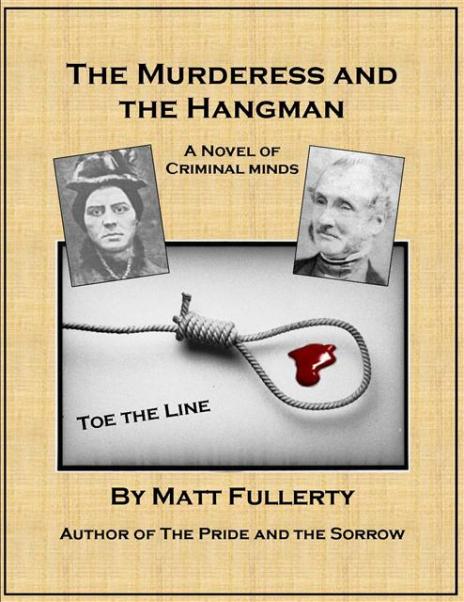
The Murderess and the Hangman - will she escape the hangman?


Wednesday, August 12, 2009

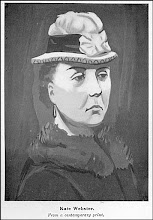
Kate Webster - London murderess! - did she do it?

Kate Webster on Facebook


My novel about painting, criminality, and the greatest art forger of the twentieth century!

My novel about painting, criminality, and the greatest art forger of the twentieth century!
Please click the cover!

My novel about London, murder, mayhem, and a female killer!

My novel about London, murder, mayhem, and a female killer!
Please click the cover!

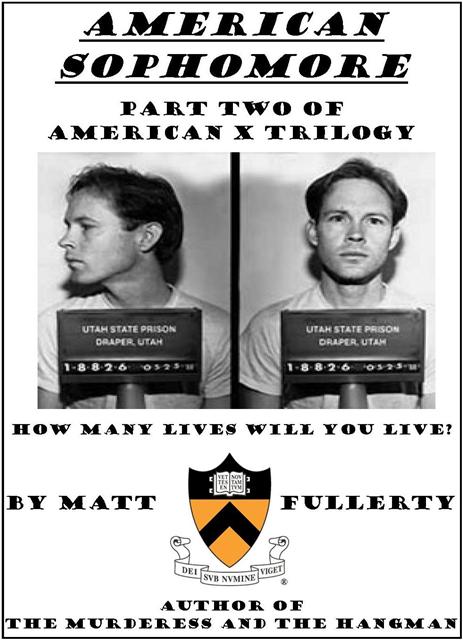
My novel about running, Princeton University, and a conman who lost it all!

My novel about running, Princeton University, and a conman who lost it all!
Please click the cover!

My novel about love, betrayal and chess in New Orleans

My novel about love, betrayal and chess in New Orleans
Please click the book!

My semi-autobiographical novel about a very British education and becoming an American!

My semi-autobiographical novel about a very British education and becoming an American!
Please click the cover!

My novel about London, murder, mayhem, and a female killer!

My novel about London, murder, mayhem, and a female killer!
Please click the cover!