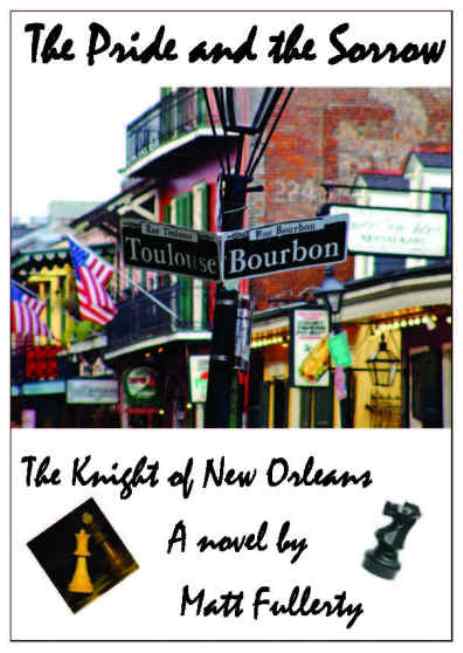
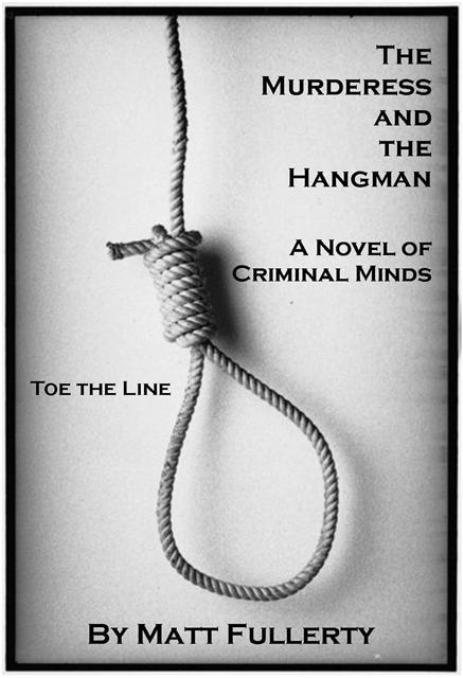
My novel about love, betrayal and chess in New Orleans: The Pride and the Sorrow

Showing posts with label USA. Show all posts

Monday, March 29, 2010

Top 100 Creative Writing Blogs


From poetry to lengthy prose, creative writing can be a great way to express yourself. Of course, even the best students and writers can use a few tips, a little inspiration and a whole lot of help getting their work out there. These blogs offer all of that and more. From blogs that focus on writers still trying to make it in the publishing world to those providing updates from best selling authors, you’ll find all kinds of information geared towards improving and informing your creative writing.

General

These blogs cover a wide range of issues for students of the written word.

  1. Writer Unboxed: Learn both about the creative and business sides of fiction writing from this great blog.
  2. Backstory: Ever wonder where writers get their inspiration? You’ll find loads of posts that record just that and you can contribute your own stories as well.
  3. Write Anything: Check out this multi-author blog to find writing challenges, inspiration and shared writing.
  4. Inkygirl: Daily Diversions for Writers: This blogger not only posts about using the Internet to improve your writing but posts her own comics frequently as well.
  5. Women on Writing: Get information on writing geared just towards female writers out there.
  6. Cute Writing: Here you’ll find posts on writing, blogging and publishing and many articles focus on ways to make your work more efficient.
  7. Write to Done: If you enjoy the blog Zen Habits, you’ll appreciate this blog by the same author. This site focuses on simple, effective ways to write more, better.
  8. The Urban Muse: Freelance writer Susan Johnston provides tips and tidbits for other working writers out there.
  9. Writing Forward: From grammar tips to ideas for improving your creative writing, check out the helpful posts on this site.
  10. Writer’s Write: This blog is a great place to find information about writers, books and the publishing world.
  11. Creative Writing Corner: Connect with your creative side through the posts on this blog.
  12. Creative Writing Contests: Want to challenge your creative skills? This blog can direct you to the great number of writing competitions out there.

Aspiring Authors

These bloggers are writing on the ‘net and off, still waiting to get their best work published.

  1. The Desperate Writer: This writer and cosmetologist shares her stories on this blog, both personal and creative.
  2. Incurable Disease of Writing: Blogger Missy is getting her degree in creative writing and posts about her experiences on this site.
  3. Emerging Writers Network: If you’re just getting started in your writing career, check out this site to learn about the ins and outs of writing and about other writers working towards success.
  4. Ficticity: Check out this site to find posted stories, writing tips and even a few book reviews.
  5. Authors’ Blogs: This isn’t just one blog, but a collection of numerous aspiring writers sites, so you can take your pick of reading material.
  6. Plot Monkeys: These four bloggers talk about everything from their everyday lives to the books they love.
  7. Maternal Spark: Moms who love to write or create on the side

Published Authors

Get some advice, inspiration and motivation from these authors doing what they love and getting paid for it.

  1. The Orwell Diaries: Most writers are familiar with the work of George Orwell. Here you’ll find regular postings from his personal diaries.
  2. Tom Conoby’s Writing Blog: This blogger shares his thoughts on books he reads, his own writing and much more.
  3. John Baker’s Blog: This working writer shares his passions– reading and writing– on this site.
  4. The Man In Black: Young mystery writer Jason Pinter shares his thoughts on just about everything on this blog.
  5. Neil Gaiman’s Journal: This well-known writer has published a large number of books, several of which have been made into major motion pictures. Check out his blog for more about what he’s working on right now.
  6. Wil Wheaton in Exile: Readers of this blog might recognize his name from his days on Star Trek: The Next Generation but these days this actor spends more of this time writing books and posting on his blog.
  7. A Writer’s Life: Love the TV series Monk? Learn more about the writer behind the books the series is based on from this blog.
  8. The Paperback Writer: With several published books under her belt, this blogger shares her writing tips as well as information about her personal life.
  9. Pocket Full of Words: Novelist Holly Lisle shares her experiences as a writer on her blog.
  10. Beyond the Beyond: Bruce Sterling has written numerous science fiction novels and now shares his thoughts on science and technology on his WIRED blog.
  11. Contrary Brin: Scientist and author David Brin maintains this site where readers can talk about issues from his books or just about anything else.
  12. Scott Berkun: This author teaches creative thinking, writes books and give public talks. Read about his writing adventures and otherwise here.

Improving Your Craft

Get some tips on becoming a better writer from these blogs.

  1. Becoming a Writer Seriously: Aspiring writers can find all kinds of helpful advice and guidance on this blog.
  2. WordSwimmer: Learn to understand the writing process a little better with a little help from blogger Bruce Black. There are loads of interviews with authors as well as suggestions on improving your writing.
  3. Time to Write: Blogger Jurgen Wolff wants to strike a creative spark in writers of all kinds by providing tips and inspiration here.
  4. Flogging the Quill: Check out this blog to learn more about the craft of creative storytelling.
  5. Six Sentences: What can you write in six sentences? Share your attempt at this writing exercise on this blog.
  6. Luc Reid: From tips on finding time to practice writing to information about the publishing industry, you’ll find loads of helpful posts on this blog.
  7. The Writing Show: While more podcast than true blog, this site is a good place for writers to get answers to their questions and get help finding inspiration.
  8. Men With Pens: Whether you’re a writer freelancing or just writing for fun, you’ll find tips on how to do it better on this blog.
  9. Write a Better Novel: Make sure whatever you’re writing will get the attention it deserves when time comes to get it published. This blog provides all kinds of information on creating a better novel, no matter the subject.
  10. Write Better: Here you’ll find a wide range of writing tips to get your creative writing in top shape.
  11. Clear Writing with Mr. Clarity: Learn to get to the point and write clearly and concisely whether you’re writing a letter at work or working on a book.
  12. Mike’s Writing Workshop: This blogger is all about posting things that can help writers get better and get inspired.
  13. Kim’s Craft Blog: Learn about writing fiction, memoirs and other creative writing from this writer who teaches courses at The Cambridge Center for Adult Education.

Grammar and Editing

You may have the best ideas but that doesn’t mean much if you can’t write them well. These blogs will help you tune up your writing so it’s publish-worthy.

  1. GrammarBlog: Laugh at the grammar and spelling errors of others while getting tips on improving your own skills on this blog.
  2. Evil Editor: This editor might be evil, but the tips provided on this blog can really help you refine your stories.
  3. Blue Pencil Editing: This blog is both a good resource for working editors and and writers in search of a little guidance.
  4. Editing and Proofreading Hints and Tips: Get simple tips on improving your editing process from this blog.
  5. Headsup: the blog: Here you’ll find posts about the sometimes frustrating world of editing and learn what not to do.
  6. Grammarphobia: This site offers readers the chance to ask their own grammar and language questions and get answers.
  7. Apostrophe Abuse: Think you know how to use the apostrophe? This blog might teach you otherwise.
  8. Daily Writing Tips: Get some daily advice on how to improve the basics of your writing.
  9. ProWriting Tips: This blog is home to numerous grammar and writing tips.
  10. The Engine Room: JD, a copy editor, runs this blog all about language use that can help you get a handle on your usage.
  11. Cheryl Norman, Grammar Cop: If you’ve got some questions about grammar that need answering, visit this blog.
  12. English4Today: Get a handle on the English language through the guidance of blogger Anthony Hughes.

Getting Published

The ultimate goal for many students and professionals working on creative writing is to get work published. This blogs can help you learn about the business, get your work out there, or even publish it yourself.

  1. Ask Allison: Ask your questions about breaking publishing and gets answers from this helpful blogger.
  2. Guide to Literary Agents: Get some tips on where and how to find a literary agent to represent your work when the time comes.
  3. Beacon Literary Services: Emerging writers and those with a little experience under their belts alike can take advantage of the publishing advice offered here.
  4. Questions and Quandaries: This Writers Digest blog answers a wide variety of questions about publishing.
  5. Writer Beware Blogs: While you may be desperate to get your work out there make sure you protect yourself from scams. The information in this blog can help you stay safe.
  6. The Swivet: Colleen Lindsay is a literary agent and you can read her reactions to recent publications and if you meet her requirements even submit your own work.
  7. The Rejecter: This blogger isn’t a literary agent but an assistant to one, the person you’ll have to go through to get your work published, and she posts all about her work on this blog.
  8. Booksquare: This blog works to dissect the publishing industry so you can learn it inside and out.
  9. Pubrants: Literary agent Kristen blogs about everything publishing from queries to working with writers.
  10. Nathan Bransford Literary Agent: Want to know more about literary agents and the publishing world? Check out this blog.
  11. Practicing Writing: This blog posts plenty on writing advice as well as the latest publishing opportunities.
  12. Bob Baker’s Full-Time Author Blog: Thinking of making the leap to being a full-time writer? This blog can be a great resource on publishing your own book to set the stage.
  13. Future Perfect Publishing: Explore all the possibilities for publishing that are out there through the help of this blog by Tom Masters.

Genre Focused

These creative writing blogs focus on one particular type of writing, such as mysteries, romance and fantasy.

  1. Storytellers Unplugged: This multi-author blog is contributed to by writers, editors and publishers and can give you a great background on writing in a wide range of genres.
  2. Gibberish: Science fiction and fantasy writer Jayme Lynn Blaschke posts about his writing and more on this site.
  3. SF Signal: From books to movies, you can keep abreast of all the goings on in world of science fiction through this blog.
  4. SF and Fantasy Novelists: Here you’ll find loads of information on writers working in the science fiction genre.
  5. Reading, Raving and Ranting: If you’re interested in historical fiction you can read about Susan Higginbotham’s experience writing about fourteenth-century England.
  6. Myth and Mystery: Novelist and contributor to the New York Times Rick Riordan is a mystery writer and you can read about his latest work on this site.
  7. Type M for Murder: Learn a little bit about murder mysteries from this multi-author blog.
  8. Crime Fiction Dossier: If crime fiction is your thing, you’ll learn loads from this blog by David Montgomery.
  9. Jungle Red: Six mystery writers contribute to this blog that talks about writing, life, love and much more.
  10. Romancing the Blog: This blog is home to numerous romance novelists who post on just about everything.

Fiction Writing

Most creative writing falls into the category of fiction, so learn more about writing great novels and stories from these blogs.

  1. Advanced Fiction Writing: Written by the "mad professor" of fiction writing, this blog is geared towards inspiring you and getting you writing.
  2. Writing Fiction: Here you’ll find a lively discussion about writing and publishing novels and short fiction.
  3. Killer Fiction: With five published authors contributing to this blog, you’ll get loads of tips and posts on writing.
  4. Ginny’s Fiction Writing Blog: Ginny Wiehardt posts about fiction writing in this About.com blog.
  5. Becoming a Fiction Writer: This blogger is following her dream of becoming a fiction writer.
  6. Blog Fiction: If you plan on taking to the net with your writing, this blogger can give you all kinds of tips on doing it right.
  7. Fiction Writers Review: The writers who run this blog are all about reviewing books but they also discuss what works and what makes truly great fiction.
  8. Angela Booth’s Writing Blog: Whether you’re writing fiction or just freelancing, you’ll find helpful writing tips on this blog.
  9. Fiction Writing: The Passionate Journey: You won’t become a great writer overnight. This blog can help you start and keep going along your journey to writing success.
  10. Fiction Scribe: From grammar errors to book tours, this blog talks about a wide range of issues affecting fiction writers.

Poetry

If verse is more your thing, pay these helpful blogs a visit.

  1. Avoiding the Muse: Doctor, blogger and author C. Dale Young maintains this blog as well as teaching an MFA program on writing.
  2. Poetry Hut Blog: Keep up to date on the latest happenings in the poetry world with this blog.
  3. Poet with a Day Job: Does the title of this blog remind you of yourself? Read this blogger’s posts on writing, reading and everyday life here.
  4. 1,000 Black Lines: Posts on this blog are a single line long, some of which record daily events and others that read like lines of poetry.
  5. The Best American Poetry: Learn about some of the best poetry out there through this blog.
  6. harriet: The Poetry Foundation maintains this blog, which posts about happenings in the poetry world and speaks directly to you, the poet.
  7. Poems at the Poetry Showcase: Contribute your poetry to this blog, or read the postings of others.
  8. Poets.org: The American Academy of Poets lets you know about great poetry that’s out there through their blog.
  9. Poetry and Poets in Rags: This blogger is both a salesman and a poet.
  10. Silliman’s Blog: Here you’ll find informative posts on contemporary poets and their work.
  11. Poets Who Blog: This blog is a great resource for poets, with writing contests, posts about work and more.
--

www.bestcollegesonline.com

Friday, March 05, 2010

Regrouping After the MFA: How to Find Community Postprogram

After a brief but torrential thunderstorm in mid-June, eight writers of poetry and prose, myself included, huddled around a picnic table crowded with three-buck beer and leaves of printed-out poems, stories, and essays in the concrete garden of a Brooklyn bar. It had been almost a year since I'd taken a seat at a table with other writers to talk about the stuff, the meat of our writing—inspirations, obsessions, discoveries—and the project at hand every time each of us settles in to confront the blank page. All of us had spent an intense two years together at the MFA program at Sarah Lawrence College, a small liberal arts school nestled in woody Bronxville, north of New York City. Many of us had migrated to the city after graduation, and while we saw one another often enough, touching base at parties and readings, our writing lives had become privatized, with only the most dramatic aspects—I haven't been excited by a word in three months! My thesis is moldering!—shared among us. So, about thirteen months after graduating, a group of friends and I, guided by our assiduous organizer, Hossannah Asuncion, decided to create a new program in order to reestablish the connection that the MFA experience had provided. We would get together once a month to check in with one another, warm ourselves up with a few brief free-writes, and discuss a predetermined topic on which we had all read a few essays before meeting. We could also bring works-in-progress to share, though workshop-style critiquing would not be on the agenda—our gatherings would celebrate our writing as art, and our work as artists.
Perhaps the shocking burst of rain was an apt metaphor for the two brief years we'd been ensconced in, and saturated by, a lively stream of words. The way whole days of digging in to work felt like a deluge after which the world often shone. The way words became new again in the voice of a classmate, and how the dross would be purged by the workshop process, revealing the tender bones and pulse of a piece. A creative writing program had offered to many of us an ideal experience—and then it was over. Of course, a workshop-heavy curriculum can have debilitating effects as well: Participants can tire of their work's being scrutinized in its infancy; differences in critical approaches can stifle discussion; and the compounded anxieties of the final semester can weigh on relationships, especially as solitary time to write becomes precious and staunchly defended. I'm sure the capacity for inducing this exhaustion informs our universities' having limited the MFA track to two or three years. After a while we're inundated and need to move out on our own. But writing programs don't tend to teach the skill set required to work fruitfully—and joyfully—beyond their gilt walls.
The MFA experience does not necessarily prepare us to be writers in the world. Our time as students is set apart as a sacrosanct period during which we perform the very important work of honing and polishing our craft, but little guidance is given as to how we might preserve that sacred lifestyle (as well as the more profane, yet necessary, moments of criticism and editing) once outside the bubble. On the other hand, no one could have told us then that our devotions would flag and that distractions—such as earning a living and making our way in the world—would threaten to prevent us from writing altogether.
This is not to say that constant connection to a writing community is necessary, or even entirely healthy. Once I'd successfully cast off those workshops and conferences, a momentary sense of liberation washed over me. When my thesis crossed over into the hands of my advisers, I was immediately walloped by a profound exhaustion, and there was freedom in that fatigue. I needed a break from the intensity of the MFA experience—from workshops, and even from writing. The project I had immersed myself in for two years (at times a desperate, sinking immersion) had worn me out, and I required some time to let the omnipresent criticism, however sparkling or seductively constructive, settle within me. It was like recovery after a marathon, when my legs were ripped and clunky and I needed to cross-train for a while, to teach myself how to move again. But the respite from writing and talking about writing soon devolved into a drab routine. Instead of slowly starting over, I had let myself stiffen, and the loss of my teammates—and our shared field—made the process of resuming the race profoundly difficult.
Excuses abounded. At first, no amount of time seemed long enough to sit and work, and when I'd attempt to write in short spurts, the words danced only on the surface of ideas and questions. Sometimes language simply felt inert. I often had the sense that I was playing with plastic blocks rather than textured, living things. Some pleasure had seeped out of the project of making art with words—a joy that I have discovered came from sharing both my poetry and the process of writing it. While I can't say this perception was common to all my peers, it seems that each of us has experienced an occasion—however extended—of craving community.

In Asuncion's experience, it has been a struggle to continue the writer's life after leaving an MFA program. In a society that often diminishes the value of the written word, students of fine writing can find their ventures trivialized as flighty or idealistic. "More often than not, I feel like the world is telling me that doing an MFA program was a bad decision," she says. "And more often than not, I'm like, ‘Yeah, time to start studying for the LSATs.'"
"I often feel stuck in my writing life," fellow salon member Rena Priest recently told me. "I have long patches of time where nothing I write is satisfying to me, and I have periods where nothing I read is resonating. When I am with other writers talking about writing and all the triumphs and struggles it involves, the ennui recedes." For Hila Ratzabi, another member of our group, connecting with other writers forces her to think about writing and to return it to the forefront of her mind where it belongs—but from which it can quietly slip as the static of the world interferes with our creative frequencies. "Thinking and talking about writing are not the same as writing, but having a community where it's safe to say, ‘I haven't written in months, and it sucks, but here's who I read when I can't write' is a blessing," Ratzabi says.
Without the meeting of friends and colleagues to help reframe myself in my project—and in the living portrait of us all doing this work together—writing began to feel like a secret game of limited consequence. I felt as if my contributions to anything larger than myself were nil. In fact, at our second salon, the question was posed, "To whom do you write?" For several months, I noticed, I had been writing primarily to words themselves, fiddling with language with nothing much at stake. My work on the page was reflective of my practice: scrawling on the train or for a few minutes at lunchtime, or making mental notes while running. I didn't feel I had an audience, and, curiously, my writing had even receded from conversation with my imaginary listeners, Dickinson and Stein among them. During my time at graduate school, the writing process itself had induced an exceptional sense of accomplishment, a purposefulness that comes from knowing that one is doing the work that one is supposed to be doing.
At times, the validation that we achieve through being and acting—in this case, writing—genuinely wavers, and we are compelled to look to one another not for appraisal but for support. Asuncion, who had rounded us up with the aid of a Google group she and others had created for Sarah Lawrence MFA alums, was inspired to start the salon by a similar series of gatherings she'd been attending that had been organized by Kundiman, the Asian American poets organization, whose members began running informal salons in January. She experienced the salon format as more of a generative field than an editing session for pieces in assorted stages of existence. Asuncion herself has written several pieces this year as a result of short salon exercises. For our group, exercises have ranged from creating a portrait based on a character we frequently noticed at our meeting spot—the mustachioed fellow leaning over his Belgian ale doesn't know how many weird narratives were spun about him—to drafting radical rewrites of work we'd each brought to the table. But most central to the salon, and for me its most vital aspect, is topical discussion.
I have always thrived in arenas that celebrate and engage ideas in all their intricacy and malleability, particularly ideas relating to perceptions of language. While not all classrooms are equally conducive to such vigorous exploration, the MFA roundtable at which I participated provided such a space and, ultimately, fed my writing. The salon reinvigorated that part of me that had been too easily neglected after leaving school, quelled by the seeming urgency of daily routines and pursuits unrelated to writing. In several of our conversations we've discussed how we can each create a space, physical and mental, where writing matters and can thrive after the intensity of the MFA experience. I've found that before establishing that room of one's own, separate from the mesh of the world, one needs to acknowledge that each of us is not alone in our endeavor; we are part of both a tradition and a living multitude of others.

As the very act of coming together on equal terms for a salon has reminded us that we are not isolated as writers, the material of our discourse has illuminated the fact that, despite having distinct styles and drives, we share a mutual human project. For discussion during our second meeting, Asuncion chose two essays on spirituality: Federico García Lorca's 1933 lecture "Theory and Play of the Duende" and Fanny Howe's "A Leaf on the Half-Shadow," published in the journal English Language Notes in 2006. These works stimulated a conversation that took off from group members' personal accounts of having sensed attunement to the spiritual while engaged in the process of writing—feeling the pull of flow, not knowing from where words were arriving; being moored in a mind state so lush and tangible, but beyond the realm of the known; approaching meditative clarity while working. My most gratifying writing hasn't been fed by my head, but by a universal, oceanic "something" exterior to ego. Without clear language to discuss phenomena such as this, experiences can feel ephemeral, or even inconsequential. But gathering with a group that understands and empathizes with the challenges posed by the shifting creative mind, and the elations that arise from meeting those challenges, I see that the importance of my work becomes more resonant.
In her essay "Survival in Two Worlds at Once: Federico García Lorca and Duende," Tracy K. Smith writes, "There are two worlds that exist together, and there is one that pushes against the other, that claims the other doesn't, or need not, exist." She refers to the capacity of duende, or the dark spirit (which some in our salon group perceived as death itself, the palpable movement of our own mortality within us), to both pull us toward and repel us from what some might call a higher state, a vaster consciousness, a discovery. In some ways, our lives outside of writing facilitate that centrifugal pushing away, and as I and many of my compatriots have found, a community that validates the opposite—a fearless movement toward the dark other—encourages the writing to approach those uncomfortable places. Talking about the act of writing has helped each of us to realize how much that wilder world does need to exist, and to negotiate its importance in our lives.
According to that Psych 101 standard, Abraham Maslow's hierarchy of needs, when certain basic human requirements are met, our minds are free to explore more philosophical realms. Granted, as graduate students none of us was living a plush life, but we were able to focus less on the minutiae of survival and ego-driven pursuits (notwithstanding the occasional lovesick breakdown or ravenous scavenge for leftovers after a school event) and more on larger pursuits. There was art to be served, and it was our one and only job to serve it. In some respect, many of us joined an MFA program believing that if we wanted our writing to evolve from the fruit of our labor into art, it had to enter the public realm. It had to take a place at the table and enter into discourse with all of the other works that have been and continue to be written. While submitting pieces for publication and seeking opportunities to read remain excellent means of propelling the work into the world, nothing beats offering the tiny body of a poem or story to the live hands of a reader, or feeling that your quietest, most shuttered of lives is in conversation with another. Our postprogram salon has offered us not only a lively arena for sharing our writing with others, but, more important, it's given us a renewed opportunity to share our writing selves with a community of kindred minds each encountering distinct but similar challenges, as emerging artists in the wider world.
--
Send us a glimpse of your post-MFA story: your toughest—or brightest—transitioning moment, the virtues and vices of your program in retrospect, or a way you found to keep your community solid. Include "Post-MFA Story" in the subject line of an e-mail to editor@pw.org.
Jean Hartig is the editorial assistant of Poets & Writers Magazine. Her chapbook, Ave, Materia, won the Poetry Society of America's New York City Chapbook Contest and is forthcoming in 2009.


Monday, March 01, 2010

The Case of Amy Bishop: Violence that Art Didn't See Coming

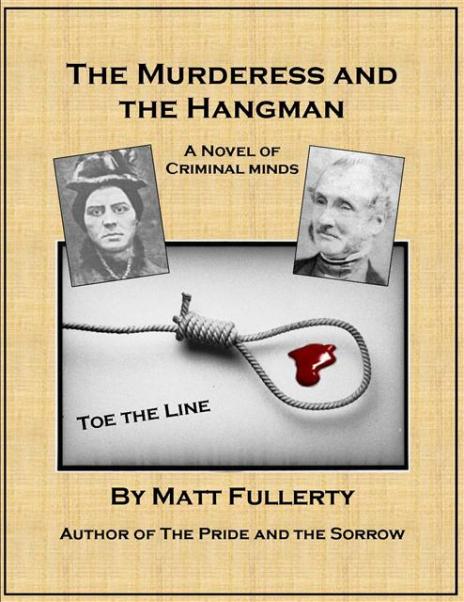
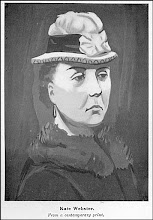
This is Kate Webster, female killer from my novel The Murderess and the Hangman. For more about the novel, please see my homepage here.

The following article from The New York Times deals with the role of female killers and art, particularly in light of the recent shootings by Amy Bishop, a professor at the University of Alabama.

--
When Ezra Pound declared in 1934 that “artists are the antennae of the race,” and Marshall McLuhan 30 years later called them people “of integral awareness,” both were using modern terms to update the ancient belief that works of the imagination might actually require a talent not only for invention but for attunement — for picking up signals already in the air. This is why the most forceful narratives and dramas seem less made up than distilled. They clarify events and experiences taken directly from the actual world.
Thus, the Jazz Age is better known through the fiction of F. Scott Fitzgerald, who captured its energies in real time, than through any number of retrospective studies. And the alienated teenager, that fixture of modern American life, didn’t fully exist until J. D. Salinger, with his faultless ear and attentive eye, coaxed him into being.
But every now and then, it seems, a gap is exposed. Events occur; art offers no guidance. The powers of imagination and attunement falter. Artists suffer a collective loss of awareness. “The culture” emits signals, but they are picked up only fitfully or are missed altogether.
Consider the case of Amy Bishop, the neuroscientist arrested for shooting six colleagues, killing three, at a department meeting at the University of Alabama in Huntsville. Rampages of this sort have become familiar. But with rare exceptions they have been the preserve of men: lonely, alienated psycho killers with arsenals of high-powered weapons and feverishly composed manifestos.
With remarkable suddenness Dr. Bishop has disrupted the pattern. When she reportedly discharged her 9-millimeter handgun, she also punctured longstanding assumptions, or illusions, about women and violence — particularly as a fuller picture of her past begins to emerge, much of it indicating a possible record of previous violent episodes, including the shooting death of her brother in 1986, and her suspected role in assembling a pipe bomb mailed to a faculty member at the Harvard Medical School in 1994, when Dr. Bishop was studying there.
It is not news that so-called senseless acts often unfold along the coordinates of an inner logic. This is what makes criminal violence so attractive a topic for artists and thinkers. The Western literary tradition, from Shakespeare to Dostoevsky, teems with pathologically violent men. Norman Mailer and Truman Capote wrote nonfiction masterpieces about them. They dominate the novels of Don DeLillo and Robert Stone, not to mention films by Sam Peckinpah, Francis Ford Coppola and Martin Scorsese.
But the landscape of unprovoked but premeditated female violence remains strangely unexplored. Women who kill are “relegated to an ‘exceptional case’ status that rests upon some exceptional, or untoward killing circumstance: the battered wife who kills her abusive husband; the postpartum psychotic mother who kills her newborn infant,” Candice Skrapec, a professor of criminology, noted in “The Female Serial Killer,” an essay included in the anthology “Moving Targets: Women, Murder and Representation” (1994).
Ms. Skrapec was writing at a time when Hollywood seemed preoccupied with women who commit crimes — in productions like “The Burning Bed,” the 1984 television film in which a battered wife finally sets her sleeping husband aflame, and “Thelma & Louise” (1991), in which a pair of women go on a outlaw spree after one of them is threatened with rape.
Both are essentially exculpatory parables of empowerment, anchored in feminist ideology. Their heroines originate as victims, pushed to criminal excesses by injustices done to them. The true aggressors are the men who mistreat and objectify them. So too with “Monster” (2003), in which Charlize Theron, in a virtuosic instance of empathy (and cosmetic makeover) re-enacted the story of Aileen Wuornos, a real-life prostitute who, after years of sexual abuse, began murdering her clients.
A decade or two ago this all made sense. The underworld of domestic abuse and sexual violence was coming freshly to light. And social arrangements were undergoing abrupt revision. The woman who achieved hard-won success in the workplace might well find herself, like the lonely stalker played by Glenn Close in “Fatal Attraction” (1987), tormented by the perfect-seeming family of the married man with whom she enjoys a weekend fling.
Much has changed since then, but the topic of women and violence — especially as represented by women — remains more or less in a time warp, bound by the themes of sexual and domestic trauma, just as male depictions of female violence are locked in the noir demimonde of fantasy, the slinky femmes fatales once played by Barbara Stanwyck and Lana Turner more or less duplicated by Kathleen Turner and Sharon Stone.
Put it another way. It is not hard to imagine Mr. DeLillo or Mr. Scorsese mapping the interior circuitry of Timothy McVeigh; Seung-Hui Cho, the Virginia Tech killer; or Bruce E. Ivins, the Army biodefense expert who, the F.B.I. concluded last week, committed anthrax terror in the aftermath of 9/11 — the paranoia, the lethal mix of fantasy and ruthless plotting. But what artist might do justice to Dr. Bishop and her complex story, as its details have so far been reported: the privileged upbringing; her stable marriage to a uxorious husband, who was also her collaborator on scientific inventions; their four children, some of whose homework Dr. Bishop is monitoring from her jail cell? And what of the accounts given by associates and neighbors of her personal qualities — assertive, bristling with sharp opinions, vocal on the subject of her brilliance, harboring fierce resentments?
The uncomfortable fact is that for all her singularity, Dr. Bishop also provides an index to the evolved status of women in 21st-century America. The number of female neurobiologists may still be small, but girls often outdo boys in the classroom, including in the sciences. (Mattel recently announced a new addition, Computer Engineer Barbie, to its line of popular dolls.) A Harvard Ph.D. remains a rare credential for women (as well as for men), but women now make up the majority of undergraduates at many prestigious colleges. And the tenure struggle said to have lighted Dr. Bishop’s short fuse reflects the anxieties of many other women who now outnumber men in the work force and have become, in thousands of cases, their family’s principal or only breadwinner.
These conditions have been developing for some years now. But the most advanced narratives of female violence seem uninterested in them. There is, for example, Marina Abramovic, a pioneer of performance art who will be honored in a major retrospective at the Museum of Modern Art in March, with 35 artists re-enacting five of her works. Ms. Abramovic, born in what was then Belgrade, Yugoslavia, first became a force in 1973 at the Edinburgh Festival, where she furiously stabbed a knife between her splayed fingers, bloodying 10 blades and tape recording the noises she made as she wounded herself. In 2002 Ms. Abramovic was still at it, exhibiting herself for 12 days in a downtown Manhattan installation, wordlessly moving among three raised platforms connected to the floor by ladders whose rungs were fashioned from large knives, their gleaming blades turned up.
There is also Karen Finley, whose avant-garde explorations of sexual violence put her in the middle of the federal arts-financing wars two decades ago. She is back onstage in “The Jackie Look.” Outfitted in bouffant and pearls, in imitation of Jacqueline Kennedy Onassis, Ms. Finley stands at a lectern and delivers a monologue on the female body — at one point shedding copious tears — and on the indignities ritually inflicted on public women (Michelle Obama no less than Mrs. Onassis).
All this is stimulating in its way, but it feels curiously outmoded. Although Ms. Abramovic and Ms. Finley are both charismatic presences, their antennae seem to have rusted. They persist in registering the dimmed signals of a bygone time.
For this reason, perhaps, the most useful glosses on Dr. Bishop may come from the world of popular, even pulpish, art — for instance, crowd-pleasing movies like “Black Widow,” “Blue Steel,” “The Silence of the Lambs,” Quentin Tarantino’s “Kill Bill” or even “Lost,” the ABC series. In all of them the hypothetical notion of empowerment gives way to the exercise of literal power. So too in crime novels written by women who specialize in the disordered or deranged mind. Genre art has its own limitations. But its strength is that it seeks to reanimate archetypes and is indifferent to ideological fashion.
“Everything is about power,” Patricia Cornwell, whose best-selling Scarpetta series is thick with forensic detail, maintained in an e-mail message, when asked what she made of the Bishop case. “The more women appropriate power, the more their behavior will mimic that of other powerful people.” Also: “Firearms are the great equalizer. You don’t have to be 6 foot 2 and weigh 200 pounds to kill a room full of people.”
Chelsea Cain, the author of a crime series that reverses the formula of “The Silence of the Lambs,” pitting a male detective against a female serial killer, suggested that Dr. Bishop is the latest version of an ancient figure, “the mother lioness that kills to protect herself and her family against perceived threats.”
In fact two middle-aged classics of genre literature eerily prefigure aspects of the Bishop case. In William March’s 1954 novel “The Bad Seed,” later adapted for both stage and film, an 8-year-old girl viciously murders a classmate but is protected by her mother, only to kill again. This parallels the allegations in Dr. Bishop’s case, at least according to the resurfaced police report on the death of her brother nearly a quarter-century ago.
No genre writer had sharper antennae than Shirley Jackson, whose gothic classic, “We Have Always Lived in the Castle,” first published in 1962, was reissued last fall. Its narrator is an 18-year-old multiple murderess who lives with her devoted sister and fantasizes about killing again. She is “socially maladroit, highly self-conscious, and disdainful of others,” Joyce Carol Oates wrote in a penetrating essay recently in The New York Review of Books. “She is ‘special.’ ” Words that ring ominously in the context of Dr. Bishop.
Ms. Oates, of course, has examined violence as thoroughly as any living American writer. When I asked her what she made of the case, she drew an implicit comparison between Dr. Bishop and Shirley Jackson’s narrator: “She is a sociopath and has been enabled through her life by individuals around her who shielded her from punishment.”
Ms. Oates’s feminist credentials are in good order. But her assessment comes from beyond the realm of predigested doctrine. It echoes the blunt assertion made by Ms. Cornwell: “People kill because they can. Women can be just as violent as men.”
--
Sam Tanenhaus, The New York Times, February 24, 2010

Thursday, February 18, 2010

A Word on the MaFiA

A few of you have asked me over the past few months whether I have an opinion on MFA (Master of Fine Arts) programs in creative writing, and (surprise!) I have several. It's really kind of a mixed bag and my theories/advice as to who should apply for admission to such programs and who shouldn't vary greatly based on individual circumstances, but hopefully I can dispel a few rumors and offer some very general guidelines.

For those not in the know, the MFA is a one- to three-year terminal art degree (the majority take two years to complete). By "terminal" I mean that you're qualified to teach college with said degree (until a few years ago it was also the highest degree in the field, but the growing popularity of the creative writing Ph.D. has muddied the waters somewhat). The degree can generally only be earned in fiction, poetry, playwriting, or screenwriting, with the former two being the most common disciplines. Many Very Fancy Writers™ these days do, in fact, hold MFAs from some very prestigious programs (the University of Iowa, the University of Michigan, Columbia, Cornell, Brown, the University of Texas, &c).

So the main question: do you need an MFA to be taken seriously as a writer?

The very short (and, I hope, obvious) answer: no. No one is handicapped in this industry by not having an MFA, and the actual degree itself will probably do very little in the way of securing representation or book deals for most writers. The long(er) answer is as follows, in patented Bullet-O-Vision™:

· While the physical degree may not be tremendously useful in terms of getting you an agent and a six-figure advance, your writing will likely improve tremendously as a result of taking two or so years to do nothing but read, write, and workshop fiction. If your prose is currently promising but purple, the kind of immersive study found in an MFA program could polish your writing to Very Fancy Writer-level lustre (complete with British spelling!).

· Additionally, the network of professors, mentors, visiting agents, and classmates you'd be likely to form in an MFA program can be of huge help down the line. Your professor or classmate might refer you to his or her agent; a visiting agent might take special interest in your novel-in-progress; you may end up making friends with several future agents and editors. You get the idea.

· And now, the caveats: active participation in an MFA program will almost certainly improve your writing, but most (if not all) programs are geared toward literary fiction. If you're writing young adult/children's fiction or genre fiction of any kind, the degree won't really give you the opportunity to do substantial work in those areas.

· Mentioning your MFA in a query letter to an agent probably won't impress them, unless it's from a top-tier program like Iowa or Columbia (and possibly not even then). There is simply more supply than demand when it comes to MFA graduates, and to be honest, agents are interested in your novels, not your alma maters.

· While not all graduates of MFA programs go on to teach, the degree often includes a teaching element and assumes, to some extent, an interest in academia or an academic career. If you have no such aspirations, you might want to think twice before applying.

· Finally, even though the economy seems to be recovering somewhat from the recession, it's still a very tough employment market out there. If you've currently got a good job, it might not be the best time to give it up to pursue graduate studies. True, there are several part-time and low-residency MFA options out there, but those are often unfunded, meaning you would be paying the school for your degree and not the other way around.

So, basically, my view is: if you're doing literary work, you think you might want to teach college, and you don't already have a decent job, go for the MFA. Otherwise, you might want to think twice. No one needs a license to be an author, and if you're considering pursuing the degree purely for some perceived recognition or sense of legitimacy as a writer, you might want to find a new line of work.

Sunday, February 14, 2010

A Word on Awards

With the recent announcement of the National Book Critics Circle Award finalists, I thought the time might be ripe for a brief discussion of literary awards.

Some of you may have wondered, in the process of querying various agents, when and whether it's appropriate to mention any awards you might have won for your writing. Since I don't have time for an awesome flowchart, I'll just give you a few general "Do"s and "Don't"s:

Do:

· Mention any significant awards you've won for your writing (anything from placing in contests judged at conferences to Pushcart Prizes). Obviously if you've won a National Book Critics Circle Award, a Pulitzer Prize, a Hugo, an Edgar, &c, list it. (Although quite honestly, if you have, you probably already have representation.)

· Mention any significant awards you've won for things outside your writing so long as they're relevant to your topic. (E.g., if you're writing a medical memoir, mentioning your professional qualifications and awards is not only germane, it's expected.)

· Mention any previous publications you have, excluding self-published work or work published in a magazine or anthology for which you make editorial decisions. Try to stick to short stories (mentioning where your poetry or journalism has appeared might be helpful if they're really well-known markets, but otherwise, it's just superfluous). Note: if you're submitting non-fiction, any non-fiction or journalistic credits you've got are fair game.

Don't:

· Mention any writing awards that are not a big deal. This includes that ninth-place award you got in your hometown (population: 200) newspaper for your short story about a cat and a dog who become bros despite the biological and social forces working against them.

· Mention any writing awards you won as a child (unless you are still a child or that award is a big deal; see above). No one cares that you got a "Most Thoughtful Essay" award in fourth grade for your three-paragraph treatise on Betsy Ross.

· Try to trick the agent. (Fun fact: everyone in the industry knows that anyone with $50 can nominate themselves for a Pulitzer. Telling us you're nominated won't fool us.)

· Mention where you earned your undergraduate or graduate degree(s), except maybe an MFA, and even then, be judicious. Agents are interested in your book, not the school(s) you attended. (This is not the case if your professional credentials are part of your platform; see above.)

In short: if you've won an award or otherwise earned some kind of recognition that you believe sets you apart from 90% of the crowd, include it. Otherwise, don't put it in your query; when push comes to shove (and it will, gentle authors), agents and editors only care about your novel and your willingness to promote it (in that order). No more, no less.

Thursday, February 11, 2010

Where a writer is from is neither here nor there

UK Border agent checks a passport

Passport control at Gatwick Airport.

We should beware of paying more attention to a writer's nationality than their fiction.

In the literary world, there is perhaps nothing more insulting than being labelled "insular". Any accusation – such as Nobel prize permanent secretary Horace Engdahl's 2008 comments about the parochialism of American letters – is damaging, hurtful and also guilt-inducing. Insularity, after all, is inimical to literature, the opposite of fiction's artistic goal of understanding others. And it's not just writers who are shamed by the allegation. Publishers and, by implication, readers are often indicted on similar charges, their rigid tastes blamed for the shockingly low availability of fiction in translation.

The idea of insularity cropped up in a hugely enjoyable and occasionally bristly recent panel discussion between Aleksandar Hemon, AS Byatt and Tom McCarthy. Together to celebrate the launch of Best European Fiction 2010 – which Hemon edited – the three novelists gave a fascinating insight into what European fiction meant to them, where its boundaries were drawn and what, if anything, bound it together. While the conversation was provocative and illuminating, it was a single comment from AS Byatt that stuck with me as I picked up the anthology later that night. Byatt – about whose fiction I may be critical, but whose understanding, perception and passion for world literature is inspiring – mournfully bemoaned the fact that she knew only one Albanian writer, Ismail Kadare. It was a frustration that seemed both entirely genuine and at the same time slightly acquisitive – as though she saw literature as a sort of Risk board, with Albania a weak point of entry that needed bolstering.

It wasn't hard to see her point: for a reader as avid and engaged as Byatt, to be ignorant of writing from anywhere on the globe is to miss out on new voices, new methods of expression, new windows on different cultures. But to me she seemed to be going at it all wrong. Does it really matter that she's only read one Albanian novelist? Is it acceptable to know two Belgian writers but for them both be Francophone rather than Dutch speaking? In short, does it really make a difference where the hell these people are from?

If there's an answer to this question, Best European Fiction 2010 isn't the place to find it. It does not claim to be a complete overview of a continent's literature, nor does it confer national-writer status on those sandwiched between its yellow covers. As Zadie Smith writes in her preface, "Anthologies are ill-fitting things – one size does not fit all." What it offers, instead, is a partial snapshot of Europe's concerns, a whistle-stop tour of old and emerging literary territories, some of which are familiar (Alistair Gray's Scotland; Victor Pelevin's Russia), others discovered for the first time.

Hemon has done an astonishing job in lighting up the map of Europe, opening the doors to these writers, many of whom – Michał Witkowski, Antonio Fian and Ornela Vorpsi in particular – I hope will become more widely known in the English-speaking world. But it hasn't encouraged me to seek out more Polish, Austrian and Albanian literature. Nor has it made me feel that I need to look for countries not included in the collection and find out about their cultural heritage. Their sensibilities as writers are necessarily bound up in their particular upbringings and cultures: centring on them simply as Poles, Austrians or Albanians is to denigrate their status as authors. As readers we should resist tokenism as much as insularity.

It's anticipated that the Best European Fiction anthology will become an annual publication, which should go some way to bringing such exceptional voices to the attention of anglophone readers. If this is the case, this volume will certainly become a highlight of the cultural year. But I hope that in future editions, the writers will be arranged alphabetically, their country of origin left as nothing more than an interesting endnote at the back of the book.

--

Stuart Evers, Wednesday 27 January 2010


Thursday, January 28, 2010

J D Salinger dies, aged 91

Catcher in the Rye author JD Salinger has died of natural causes at his home in New Hampshire.

JD Salinger, who shocked one generation and inspired another with a classic novel of teenage rebellion, has died in New Hampshire at the age of 91.

Salinger, who shied away from publicity and did not publish an original work during the last 45 years of his life, was the creator of Holden Caulfield, the delinquent, alienated anti-hero of The Catcher in the Rye, which became required reading for generations of teenagers after its publication in 1951.

But in recent years its relevance to modern youth came into question and his reputation was tarnished by two accounts, one by a former lover and the other by one of Salinger's daughters, who painted him as a controlling and unpleasant eccentric.

The Catcher in the Rye was praised by the New York Times on publication as "an unusually brilliant first novel". But while an instant hit with many teenagers who related to its tale of adolescent angst and adult hypocrisy, it was met with alarm in other quarters. Some school boards made it required reading. Others banned it amid protests from parents over swearing – including the frequent use of "goddam" and, more rarely, "fuck" – as well as the bad example they believed Holden set.

Four years after its publication Salinger expressed disappointment that the book, which he acknowledged was based on his own upbringing, had met with some hostility.

"I'm aware that a number of my friends will be saddened, or shocked, or shocked-saddened, over some of the chapters of The Catcher in the Rye. Some of my best friends are children. In fact all of my best friends are children," he wrote in 20th Century Authors. "It's almost unbearable to me to realise that my book will be kept on a shelf out of their reach."

John Lennon's murderer, Mark Chapman, cited The Catcher in the Rye as an inspiration for the killing in 1980.

Salinger published other books, including the well received Nine Stories and Franny and Zooey, before he became an almost total recluse. His last published work – Hapworth 16, 1928 – was printed in The New Yorker in 1965.

Ten years ago it was revealed that Salinger had a secret cache of about 15 novels that had never been published. In his last interview, in 1980, he said that he only wrote for himself.

In 1986 Salinger won an injunction against the publication of a collection of his letters. During the case, which went all the way to the US supreme court, he was asked what he had been working on for the previous 20 years.

"Just a work of fiction," Salinger said in a deposition. "That's all. That's the only description I can really give it ... It's almost impossible to define. I work with characters, and as they develop I just go on from there."

Salinger was born in New York City on New Year's Day 1919. His father, of Polish Jewish origin, became wealthy importing cheese and meat. His mother posed as Jewish and he did not find out that she was not until after his bar mitzvah.

Salinger had his own troubled history in various schools until he was dispatched to Valley Forge military academy at the age of 15. There he began writing at night using a torch under his bed covers and published his first story in a fiction magazine in 1940.

He submitted a number of stories to the New Yorker that were rejected, including one called I Went to School with Adolf Hitler. But the magazine did accept a later story about a disaffected teenager called Holden Caulfield, the first time the character appeared.

In 1942 Salinger was conscripted to fight in the second world war where he took part in the Normandy landings. He married a German woman while serving with the occupation forces after the defeat of Hitler. The couple moved to America but the marriage soon fell apart. Salinger took up Zen Buddhism.

He found fame disagreeable and the year after the publication of his most famous novel he left New York city for the town of Cornish, New Hampshire. There he remarried, to Claire Douglas, had two children, and then divorced in 1967.

Periodically the spotlight shone on Salinger again.

In 1998 the writer Joyce Maynard published a memoir in which she wrote unflatteringly about an eight-month affair with Salinger in which she described his controlling personality. Two years later one of Salinger's daughters, Margaret, wrote of her father as a recluse who drank his own urine and spoke in tongues.

Salinger was thrust into public view one last time a year ago when he sued to block the publication of an unauthorised sequel to The Catcher in the Rye called 60 Years Later. The writer, John David California, imagined Holden in his 70s.

--

Chris McGreal in Washington, The Guardian, Thursday 28 January


Thursday, December 17, 2009

Hollywood writer Tweeting from jail

Roger Avary, the Pulp Fiction story writer, is tweeting observations from behind bars.

Sentenced last month and currently serving a year’s prison sentence for driving under the influence and vehicular manslaughter, Avary’s musings could be seen as inspirational to most fledgling writers. In fact, The Scribbler would like to think Avary has already bagged half a dozen ideas for new writing projects.

There are many theories about how Avary is managing to Tweet from Ventura County Jail. One suggests that while serving a year’s custodial sentence and five probation, the Californian justice system saw fit to grant Avary a work furlough allowing him to work on Return to Castle Wolfenstein, his current film project based on the hit computer game, before returning to prison at night. If this was the case we’re sure it would be more widely publicised.

Other reports suggest he’s using his telephone call to phone his 140 character Twitter update to a friend who then updates his profile for him. Or a third idea is that he is microblogging using a mobile phone application. Regardless of how he is doing it, one thing’s for sure, Avary’s Tweets are gradually building a very vivid picture of what life is like inside a correctional institution.

Roger Avary’s other writing credits include; Reservoir Dogs, True Romance, Killing Zoe, Rules of Attraction, Glitterati and Beowulf.

Follow Roger Avary’s Twitter account here: @AVARY Let us know if you find it good reading in the comment box below. His website can be found here: www.avary.com

Also follow The Scribbler on Twitter here: @ScribblerBlog

Feast your eyes on a famous example of Roger Avary’s talent below. A drug induced scene from his film Killing Zoe:

Discussion:
What do you think of Roger Avary’s Twitter? Has it inspired you in any way? Is it a good resource for research in life from behind bars? Are you now bitten by the Twitter bug? How can social networking benefit the writing process? Please do discuss below.

--

Words: Dean Samways


Friday, December 04, 2009

Quote of the Week, #4

The very first thing the President did was to show me the new Presidential Seal, which he had just redesigned. He explained, 'The seal has to go everywhere the President goes. It must be displayed upon the lectern when he speaks. The eagle used to face the arrows but I have re-designed it so that it now faces the olive branches… what do you think?' I said, 'Mr. President, with the greatest respect, I would prefer the American eagle's neck to be on a swivel so that it could face the olive branches or the arrows, as the occasion might demand.'
Winston Churchill to Harry S. Truman, 1946


Monday, November 30, 2009

The problem with Nabokov...


Vladimir Nabokov's unfinished novella, The Original of Laura, is being published despite the author's instructions that it be destroyed after his death.
-
"Language leads a double life – and so does the novelist. You chat with family and friends, you attend to your correspondence, you consult menus and shopping lists, you observe road signs (LOOK LEFT), and so on. Then you enter your study, where language exists in quite another form – as the stuff of patterned artifice. Most writers, I think, would want to go along with Vladimir Nabokov (1899-1977), when he reminisced in 1974:
  1. The Original of Laura: (Dying is Fun) a Novel in Fragments
  2. by Vladimir Nabokov
  3. 304pp,
  4. Penguin Classics,
  5. £25

". . . I regarded Paris, with its gray-toned days and charcoal nights, merely as the chance setting for the most authentic and faithful joys of my life: the coloured phrase in my mind under the drizzle, the white page under the desk lamp awaiting me in my humble home."

Well, the creative joy is authentic; and yet it isn't faithful (in common with pretty well the entire cast of Nabokov's fictional women, creative joy, in the end, is sadistically fickle). Writing remains a very interesting job, but destiny, or "fat Fate", as Humbert Humbert calls it, has arranged a very interesting retribution. Writers lead a double life. And they die doubly, too. This is modern literature's dirty little secret. Writers die twice: once when the body dies, and once when the talent dies.

Nabokov composed The Original of Laura, or what we have of it, against the clock of doom (a series of sickening falls, then hospital infections, then bronchial collapse). It is not "A novel in fragments", as the cover states; it is immediately recognisable as a longish short story struggling to become a novella. In this palatial edition, every left-hand page is blank, and every right-hand page reproduces Nabokov's manuscript (with its robust handwriting and fragile spelling – "bycycle", "stomack", "suprize"), plus the text in typed print (and infested with square brackets). It is nice, I dare say, to see those world-famous index cards up close; but in truth there is little in Laura that reverberates in the mind. "Auroral rumbles and bangs had begun jolting the cold misty city": in this we hear an echo of the Nabokovian music. And in the following we glimpse the funny and fearless Nabokovian disdain for our "abject physicality":

"I loathe my belly, that trunkful of bowels, which I have to carry around, and everything connected with it – the wrong food, heartburn, constipation's leaden load, or else indigestion with a first installment of hot filth pouring out of me in a public toilet . . ."

Otherwise and in general Laura is somewhere between larva and pupa (to use a lepidopteral metaphor), and very far from the finished imago.

Apart from a welcome flurry of interest in the work, the only thing this relic will effect, I fear, is the slight exacerbation of what is already a problem from hell. It is infernal, for me, because I bow to no one in my love for this great and greatly inspiring genius. And yet Nabokov, in his decline, imposes on even the keenest reader a horrible brew of piety, literal-mindedness, vulgarity and philistinism. Nothing much, in Laura, qualifies as a theme (ie, as a structural or at least a recurring motif). But we do notice the appearance of a certain Hubert H Hubert (a reeking Englishman who slobbers over a pre-teen's bed), we do notice the 24-year-old vamp with 12-year-old breasts ("pale squinty nipples and firm form"), and we do notice the fevered dream about a juvenile love ("her little bottom, so smooth, so moonlit"). In other words, Laura joins The Enchanter (1939), Lolita (1955), Ada (1970), Transparent Things (1972), and Look at the Harlequins! (1974) in unignorably concerning itself with the sexual despoiliation of very young girls.

Six fictions: six fictions, two or perhaps three of which are spectacular masterpieces. You will, I hope, admit that the hellish problem is at least Nabokovian in its complexity and ticklishness. For no human being in the history of the world has done more to vivify the cruelty, the violence, and the dismal squalor of this particular crime. The problem, which turns out to be an aesthetic problem, and not quite a moral one, has to do with the intimate malice of age.

The word we want is not the legalistic "paedophilia", which in any case deceitfully translates as "fondness for children". The word we want is "nympholepsy", which doesn't quite mean what you think it means. It means "frenzy caused by desire for the unattainable", and is rightly characterised by my COD as literary. As such, nympholepsy is a legitimate, indeed an almost inevitable subject for this very singular talent. "Nabokov's is really an amorous style," John Updike lucidly observed: "It yearns to clasp diaphonous exactitude into its hairy arms." With the later Nabokov, though, nympholepsy crumbles into its etymology – "from Gk numpholeptos 'caught by nymphs', on the pattern of EPILEPSY"; "from Gk epilepsia, from epilambanein 'seize, attack'".

Dreamed up in 1930s Berlin (with Hitler's voice spluttering out from the rooftop loudspeakers), and written in Paris (post-Kristallnacht, at the start of the Nabokovs' frenetic flight from Europe), The Enchanter is a vicious triumph, brilliantly and almost osmotically translated from the Russian by Dmitri Nabokov in 1987, 10 years after his father's death.As a narrative it is logistically identical to the first half of Lolita: the rapist will marry – and perhaps murder – the mother, and then negotiate the child. Unlike the redoubtable Charlotte Haze ("she of the noble nipple and massive thigh"), the nameless widow in The Enchanter is already promisingly frail, her large body warped out of symmetry by hospitalisations and surgeons' knives. And this is why her suitor reluctantly rejects the idea of poison: "Besides, they'll inevitably open her up, out of sheer habit."

The wedding takes place, and so does the wedding night: ". . . and it was perfectly clear that he (little Gulliver)" would be physically unable to tackle "those multiple caverns" and "the repulsively listing conformation of her ponderous pelvis". But "in the middle of his farewell speeches about his migraine", things take an unexpected turn,

"so that, after the fact, it was with astonishment that he discovered the corpse of the miraculously vanquished giantess and gazed at the moiré girdle that almost totally concealed her scar."

Soon the mother is dead for real, and the enchanter is alone with his 12-year-old. "The lone wolf was getting ready to don Granny's nightcap."

In Lolita, Humbert has "strenuous sexual intercourse" with his nymphet at least twice a day for two years. In The Enchanter there is a single delectation – non-invasive, voyeuristic, masturbatory. In the hotel room the girl is asleep, and naked; "he began passing his magic wand above her body", measuring her "with an enchanted yardstick". She awakes, she looks at "his rearing nudity", and she screams. With his obsession now reduced to a cooling smear on the raincoat he throws on, our enchanter runs out into the street, seeking to rid himself, by any means, of a world "already-looked-at" and "no-longer-needed". A tramcar grinds into sight, and under

"this growing, grinning, megathundering mass, this instantaneous cinema of dismemberment – that's it, drag me under, tear at my frailty – I'm travelling flattened, on my smacked-down face . . . don't rip me to pieces – you're shredding me, I've had enough . . . Zigzag gymnastics of lightning, spectogram of a thunderbolt's split seconds – and the film of life had burst."

In moral terms The Enchanter is sulphurously direct. Lolita, by contrast, is delicately cumulative; but in its judgment of Humbert's abomination it is, if anything, the more severe. To establish this it is necessary to adduce only two key points. First, the fate of its tragic heroine. No unprepared reader could be expected to notice that Lolita meets a terrible end on page two of the novel that bears her name: "Mrs 'Richard F Schiller' died in childbed", says the "editor" in his Foreword, "giving birth to a still-born girl . . . in Gray Star, a settlement in the remotest Northwest"; and the novel is almost over by the time Mrs Richard F Schiller (ie, Lo) briefly appears. Thus we note, with a parenthetical gasp, the size of Nabokov's gamble on greatness. "Curiously enough, one cannot read a book," he once announced (at the lectern), "one can only reread it." Nabokov knew that Lolita would be reread, and re-reread. He knew that we would eventually absorb Lolita's fate – her stolen childhood, her stolen womanhood. Gray Star, he wrote, is "the capital town of the book". The shifting half-tone – gray star, pale fire, torpid smoke: this is the Nabokovian crux.

The second fundamental point is the description of a recurring dream that shadows Humbert after Lolita has flown (she absconds with the cynically carnal Quilty). It is also proof of the fact that style, that prose itself, can control morality. Who would want to do something that gave them dreams like these?

". . . she did haunt my sleep but she appeared there in strange and ludicrous disguises as Valeria or Charlotte [his ex-wives], or a cross between them. That complex ghost would come to me, shedding shift after shift, in an atmosphere of great melancholy and disgust, and would recline in dull invitation on some narrow board or hard settee, with flesh ajar like therubber valve of a soccer ball's bladder. I would find myself, dentures fractured or hopelessly misplaced, in horrible chambres garnies, where I would be entertained at tedious vivisecting parties that generally ended with Charlotte or Valeria weeping in my bleeding arms and being tenderly kissed by my brotherly lips in a dream disorder of auctioneered Viennese bric-a-brac, pity, impotence and the brown wigs of tragic old women who had just been gassed."

That final phrase, with its clear allusion, reminds us of the painful and tender diffidence with which Nabokov wrote about the century's terminal crime. His father, the distinguished liberal statesman (whom Trotsky loathed), was shot dead by a fascist thug in Berlin; and Nabokov's homosexual brother, Sergey, was murdered in a Nazi concentration camp ("What a joy you are well, alive, in good spirits," Nabokov wrote to his sister Elena, from the US to the USSR, in November 1945. "Poor, poor Seryozha . . . !"). Nabokov's wife, Véra, was Jewish, and so, therefore, was their son (born in 1934); and there is a strong likelihood that if the Nabokovs had failed to escape from France when they did (in May 1940, with the Wehrmacht 70 miles from Paris), they would have joined the scores of thousands of undesirables delivered by Vichy to the Reich.

In his fiction, to my knowledge, Nabokov wrote about the Holocaust at paragraph length only once – in the incomparable Pnin (1957). Other references, as in Lolita, are glancing. Take, for example, this one-sentence demonstration of genius from the insanely inspired six-page short story "Signs and Symbols" (it is a description of a Jewish matriarch):

"Aunt Rosa, a fussy, angular, wild-eyed old lady, who had lived in a tremulous world of bad news, bankruptcies, train accidents, cancerous growths – until the Germans put her to death, together with all the people she had worried about."

Pnin goes further. At an émigré houseparty in rural America a Madam Shpolyanski mentions her cousin, Mira, and asks Timofey Pnin if he has heard of her "terrible end". "Indeed, I have," Pnin answers. Gentle Timofey sits on alone in the twilight. Then Nabokov gives us this:

"What chatty Madam Shpolyanski mentioned had conjured up Mira's image with unusual force. This was disturbing. Only in the detachment of an incurable complaint, in the sanity of near death, could one cope with this for a moment. In order to exist rationally, Pnin had taught himself . . . never to remember Mira Belochkin – not because . . . the evocation of a youthful love affair, banal and brief, threatened his peace of mind . . . but because, if one were quite sincere with oneself, no conscience, and hence no consciousness, could be expected to subsist in a world where such things as Mira's death were possible. One had to forget – because one could not live with the thought that this graceful, fragile, tender young woman with those eyes, that smile, those gardens and snows in the background, had been brought in a cattle car and killed by an injection of phenol into the heart, into the gentle heart one had heard beating under one's lips in the dusk of the past."

How resonantly this passage chimes with Primo Levi's crucial observation that we cannot, we must not, "understand what happened". Because to "understand" it would be to "contain" it. "What happened" was "non-human", or "counter-human", and remains incomprehensible to human beings.

By linking Humbert Humbert's crime to the Shoah, and to "those whom the wind of death has scattered" (Paul Celan), Nabokov pushes out to the very limits of the moral universe. Like The Enchanter, Lolita is airtight, intact and entire. The frenzy of the unattainable desire is confronted, and framed, with stupendous courage and cunning. And so matters might have rested. But then came the meltdown of artistic self-possession – tumultuously announced, in 1970, by the arrival of Ada. When a writer starts to come off the rails, you expect skidmarks and broken glass; with Nabokov, naturally, the eruption is on the scale of a nuclear accident.

I have read at least half a dozen Nabokov novels at least half a dozen times. And at least half a dozen times I have tried, and promptly failed, to read Ada ("Or Ardor: A Family Chronicle"). My first attempt took place about three decades ago. I put it down after the first chapter, with a curious sensation, a kind of negative tingle. Every five years or so (this became the pattern), I picked it up again; and after a while I began to articulate the difficulty: "But this is dead," I said to myself. The curious sensation, the negative tingle, is of course miserably familiar to me now: it is the reader's response to what seems to happen to all writers as they overstep the biblical span. The radiance, the life-giving power, begins to fade. Last summer I went away with Ada and locked myself up with it. And I was right. At 600 pages, two or three times Nabokov's usual fighting-weight, the novel is what homicide detectives call "a burster". It is a waterlogged corpse at the stage of maximal bloat.

When Finnegans Wake appeared, in 1939, it was greeted with wary respect – or with "terror-stricken praise", in the words of Jorge Luis Borges. Ada garnered plenty of terror-stricken praise; and the similarities between the two magna opera are in fact profound. Nabokov nominated Ulysses as his novel of the century, but he described Finnegans Wake as, variously, "formless and dull", "a cold pudding of a book", "a tragic failure" and "a frightful bore". Both novels seek to make a virtue of unbounded self-indulgence; they turn away, so to speak, and fold in on themselves. Literary talent has several ways of dying. With Joyce and Nabokov, we see a decisive loss of love for the reader – a loss of comity, of courtesy. The pleasures of writing, Nabokov said, "correspond exactly to the pleasures of reading"; and the two activities are in some sense indivisible. In Ada, that bond loosens and frays.

There is a weakness in Nabokov for "partricianism", as Saul Bellow called it (Nabokov the classic émigré, Bellow the classic immigrant). In the former's purely "Russian" novels (I mean the novels written in Russian that Nabokov did not himself translate), the male characters, in particular, have a self-magnifying quality: they are larger and louder than life. They don't walk – they "march" or "stride"; they don't eat and drink – they "munch" and "gulp"; they don't laugh – they "roar". They are very far from being the furtive, hesitant neurasthenics of mainstream anglophone fiction: they are brawny (and gifted) heart-throbs, who win all the fights and win all the girls. Pride, for them, is not a deadly sin but a cardinal virtue. Of course, we cannot do without this vein in Nabokov: it gives us, elsewhere, his magnificently comic hauteur. In Lolita, the superbity is meant to be funny; elsewhere, it is a trait that irony does not protect.

In Ada nabobism disastrously combines with a nympholepsy that is lavishly, monotonously, and frictionlessly gratified. Ada herself, at the outset, is 12; and Van Veen, her cousin (and half-sibling) is 14. As Ada starts to age, in adolescence, her tiny sister Lucette is also on hand to enliven their "strenuous trysts". On top of this, there is a running quasi-fantasy about an international chain of elite bordellos where girls as young as 11 can be "fondled and fouled". And Van's 60-year-old father (incidentally but typically) has a mistress who is barely out of single figures: she is 10. This interminable book is written in dense, erudite, alliterative, punsome, pore-clogging prose; and every character, without exception, sounds like late Henry James.

In common with Finnegans Wake, Ada probably does "work out" and "measure up" – the multilingual decoder, given enough time and nothing better to do, might eventually disentangle its toiling systems and symmetries, its lonely and comfortless labyrinths, and its glutinous nostalgies. What both novels signally lack, however, is any hint of narrative traction: they slip and they slide; they just can't hold the road. And then, too, with Ada, there is something altogether alien – a sense of monstrous entitlement, of unbridled, head-in-air seigneurism. Morally, this is the world for which the twisted Humbert thirsts: a world where "nothing matters", and "everything is allowed".

This leaves us with Transparent Things (to which we will uneasily return) and Look at the Harlequins! – as well as the more or less negligible volume under review. "LATH!", as the author called it, just as he called The Original of Laura "TOOL", is the Nabokov swansong. It has some wonderful rumbles, and glimmers of unearthly colour, but it is hard-of-hearing and rheumy-eyed; and the little-girl theme is by now hardly more than a logo – part of the Nabokovian furniture, like mirrors, doubles, chess, butterflies. There is a visit to a motel called Lolita Lodge; there is a brief impersonation of Dumbert Dumbert. More centrally, the narrator, Vadim Vadimovich, suddenly finds himself in sole charge of his seldom-seen daughter, Bel, who, inexorably, is 12 years old.

Now, where does this thread lead?

". . . I was still deliriously happy, still seeing nothing wrong or dangerous, or absurd or downright cretinous, in the relationship between my daughter and me. Save for a few insignificant lapses – a few hot drops of overflowing tenderness, a gasp masked by a cough and that sort of stuff – my relations with her remained essentially innocent."

Well, the dismaying answer is that this thread leads nowhere. The only repurcussion, thematic or otherwise, is that Vadim ends up marrying one of Bel's classmates, who is 43 years his junior. And that is all.

Between the hysterical Ada and the doddery Look at the Harlequins! comes the mysterious, sinister and beautifully melancholic novella, Transparent Things: Nabokov's remission. Our hero, Hugh Person, a middle-grade American publisher, is an endearing misfit and sexual loser, like Timofey Pnin (Pnin regularly dines at a shabby little restaurant called The Egg and We, which he frequents out of "sheer sympathy with failure"). Four visits to Switzerland provide the cornerstones of this expert little piece, as Hugh shyly courts the exasperating flirt, Armande, and also monitors an aged, portly, decadent, and forbiddingly highbrow novelist called "Mr R".

Mr R is said to have debauched his stepdaughter (a friend of Armande's) when she was a child or at any rate a minor. The nympholeptic theme thus hovers over the story, and is reinforced, in one extraordinary scene, by the disclosure of Hugh's latent yearnings. A pitiful bumbler, with a treacherous libido (wiltings and premature ejaculations mark his "mediocre potency"), Hugh calls on Armande's villa, and her mother diverts him, while he waits, with some family snapshots. He comes across a photo of a naked Armande, aged 10:

"The visitor constucted a pile of albums to screen the flame of his interest . . . and returned several times to the pictures of little Armande in her bath, pressing a proboscidate rubber toy to her shiny stomach or standing up, dimple-bottomed, to be lathered. Another revelation of impuberal softness (its middle line just distinguishable from the less vertical grass-blade next to it) was afforded by a photo of her in which she sat in the buff on the grass, combing her sun-shot hair and spreading wide, in false perspective, the lovely legs of a giantess.

"He heard a toilet flush upstairs and with a guilty wince slapped the thick book shut. His retractile heart moodily withdrew, its throbs quietened . . ."

At first this passage seems shockingly anomalous. But then we reflect that Hugh's unconscious thoughts, his dreams, his insomnias ("night is always a giant"), are saturated with inarticulate dreads:

"He could not believe that decent people had the sort of obscene and absurd nightmares which shattered his night and continued to tingle throughout the day. Neither the incidental accounts of bad dreams reported by friends nor the case histories in Freudian dream books, with their hilarious elucidations, presented anything like the complicated vileness of his almost nightly experience."

Hugh marries Armande and then, years later, strangles her in his sleep. So it may be that Nabokov identifies the paedophiliac prompting as an urge towards violence and self-obliteration. Hugh Person's subliminal churning extracts a terrible revenge, in pathos and isolation (prison, madhouse), and demands the ultimate purgation: he is burnt to death in one of the most ravishing conflagrations in all literature. The torched hotel:

"Now flames were mounting the stairs, in pairs, in trios, in redskin file, hand in hand, tongue after tongue, conversing and humming happily. It was not, though, the heat of their flicker, but the acrid dark smoke that caused Person to retreat back into the room; excuse me, said a polite flamelet holding open the door he was vainly trying to close. The window banged with such force that its panes broke into a torrent of rubies . . . At last suffocation made him try to get out by climbing out and down, but there were no ledges or balconies on that side of the roaring house. As he reached the window a long lavender-tipped flame danced up to stop him with a graceful gesture of its gloved hand. Crumbling partitions of plaster and wood allowed human cries to reach him, and one of his last wrong ideas was that those were the shouts of people anxious to help him, and not the howls of fellow men."

Left to themselves, The Enchanter, Lolita, and Transparent Things might have formed a lustrous and utterly unnerving trilogy. But they are not left to themselves; by sheer weight of numbers, by sheer iteration, the nympholepsy novels begin to infect one another – they cross-contaminate. We gratefully take all we can from them; and yet . . . Where else in the canon do we find such wayward fixity? In the awful itch of Lawrence, maybe, or in the murky sexual transpositions of Proust? No: you would need to venture to the very fringes of literature – Lewis Carroll, William Burroughs, the Marquis de Sade – to find an equivalent emphasis: an emphasis on activities we rightly and eternally hold to be unforgivable.

In fiction, of course, nobody ever gets hurt; the flaw, as I said, is not moral but aesthetic. And I intend no innnuendo by pointing out that Nabokov's obsession with nymphets has a parallel: the ponderous intrusiveness of his obsession with Freud – "the vulgar, shabby, fundamentally medieval world" of "the Viennese quack", with "its bitter little embryos, spying, from their natural nooks, upon the love life of their parents". Nabokov cherished the anarchy of the inner life, and Freud is excoriated because he sought to systematise it. Is there something rivalrous in this hatred? Well, in the end it is Nabokov, and not Freud, who emerges as our supreme poet of dreams (with Kafka), and our supreme poet of madness.

One commonsensical caveat persists, for all our literary-critical impartiality: writers like to write about the things they like to think about. And, to put it at its sternest, Nabokov's mind, during his last period, insufficiently honoured the innocence – insufficiently honoured the honour – of 12-year-old girls. In the three novels mentioned above he prepotently defends the emphasis; in Ada (that incontinent splurge), in Look at the Harlequins!, and now in The Original of Laura, he does not defend it. This leaves a faint but visible scar on the leviathan of his corpus.

"Now, soyons raisonnable," says Quilty, staring down the barrel of Humbert's revolver. "You will only wound me hideously and then rot in jail while I recuperate in a tropical setting." All right, let us be reasonable. In his book about Updike, Nicholson Baker refers to an order of literary achievement that he calls "Prousto-Nabokovian". Yes, Prousto-Nabokovian, or Joyceo-Borgesian, or, for the Americans, Jameso-Bellovian. And it is at the highest table that Vladimir Nabokov coolly takes his place.

Lolita, Pnin, Despair (1936; translated by the author in 1966), and four or five short stories are immortal. King, Queen, Knave (1928, 1968), Laughter in the Dark (1932, 1936), The Enchanter, The Eye (1930), Bend Sinister (1947), Pale Fire (1962), and Transparent Things are ferociously accomplished; and little Mary (1925), his first novel, is a little beauty. Lectures on Literature (1980), Lectures on Russian Literature (1981), and Lectures on Don Quixote (1983), together with Strong Opinions (1973), constitute the shining record of a pre-eminent artist-critic. And the Selected Letters (1989), the Nabokov-Wilson Letters (1979), and that marshlight of an autobiography, Speak, Memory (1967), give us a four-dimensional portrait of a delightful and honourable man. The vice Nabokov most frequently reviled was "cruelty". And his gentleness of nature is most clearly seen in the loving attentiveness with which, in his fiction, he writes about animals. A minute's thought gives me the cat in King, Queen, Knave (washing itself with one hindleg raised "like a shouldered club"), the charming dogs and monkeys in Lolita, the shadow-tailed squirrel and the unforgettable ant in Pnin, and the sick bat in Pale Fire – creeping past "like a cripple with a broken umbrella".

They call it a "shimmer" – a glint, a glitter, a glisten. The Nabokovian essence is a miraculously fertile instability, where without warning the words detach themselves from the everyday and streak off like flares in a night sky, illuminating hidden versts of longing and terror. From Lolita, as the fateful cohabitation begins (nous connûmes, a Flaubertian intonation, means "we came to know"):

"Nous connûmes the various types of motor court operators, the reformed criminal, the retired teacher, and the business flop, among the males; and the motherly, pseudo-ladylike and madamic variants among the females. And sometimes trains would cry in the monstrously hot and humid night with heartrending and ominous plangency, mingling power and hysteria in one desperate scream."

--

Martin Amis, The Guardian, Saturday 14 November 2009


My novel about painting, criminality, and the greatest art forger of the twentieth century!

My novel about painting, criminality, and the greatest art forger of the twentieth century!
Please click the cover!

My novel about London, murder, mayhem, and a female killer!

My novel about London, murder, mayhem, and a female killer!
Please click the cover!

My novel about running, Princeton University, and a conman who lost it all!

My novel about running, Princeton University, and a conman who lost it all!
Please click the cover!

My novel about love, betrayal and chess in New Orleans

My novel about love, betrayal and chess in New Orleans
Please click the book!

My semi-autobiographical novel about a very British education and becoming an American!

My semi-autobiographical novel about a very British education and becoming an American!
Please click the cover!

My novel about London, murder, mayhem, and a female killer!

My novel about London, murder, mayhem, and a female killer!
Please click the cover!